

Introduction about Fish Eyes
Eyes are some of the most fascinating things in nature, but what fish eyes have developed is not only interesting but also specialized. Fish can see in ways that humans and many land creatures cannot. Humans live in a different world than fish. What is fascinating about how fish are able to see is the variety. Fish eyes have been able to see in ways that we have not even begun to understand and we have only just started documenting.
Land creatures see in ways to help them function and orient in the land. Fish eyes can see in ways to help them function and orient in the water. Fish have been exposed to different environments and conditions than humans making their vision even more impressive. Just like the land, the water has many different environments and conditions, so different fish have different eyes. Different fish can see different things.
Fish Eyes and Human Eyes
Fish eyes and human eyes are not too different but once humans began to live and developed on land, it was too different from the underwater world and what fish eyes can see.
Fish eyes like human eyes have:
Cornea
The cornea is the protective outermost layer that is also the most front part of the eye. However, a fish cornea like human eyes doesn’t have much focusing and is flatter.
Lentil
The lens is one of the most important parts of fish eyes vision and unlike in humans, who change the shape of their lens to focus, many fish move their spherical lens closer to the retina to adjust focus.
This allows fish to see at varying distances even in the underwater.
Retina
Photoreceptors in the retina detect light and are used by fish eyes to identify objects, colors, and motion.
Certain fish have adapted retinas that are used to see in various lighting conditions.
How Can Fish See in Water?
Fish have a unique way of seeing that is adapted specifically for the environment of the water that they reside. Because of the way light behaves in water as opposed to in air, fish eyes have optimized their vision, leading to a variety of adaptations.
Wide Field of View
Having eyes on the sides of most fish eyes heads allows for a large field of view to better recognize motion from all angles, which is also useful when trying to avoid predators.
Better Movement Detection
Fish are better adapted to recognize motion than most organisms on land. Fish eyes are designed to quickly and efficiently notice motion in their surroundings which leads to better and quicker responses to motion in their environment. This is imperative to their ability to hunt and avoid threats.
Adaptation to Different Light Levels
Fish that dwell closer to the surface of the water typically possess more advanced color vision than deeper dwelling fish whose eyes are adapted to low levels of light.
Color Vision in Fish eyes
It is often overlooked that fish possess color vision, but in fact they have color vision that is often more advanced than that of humans. Fish are even more advanced in their color vision, some detecting ultraviolet colors. An example of fish that are more color advanced than humans are reef fish. They can use color vision to: identify predators, pick mates, identify and locate other fish, and identify and locate food.
Deep-Sea Fish Eyes and Low-Light Adaptations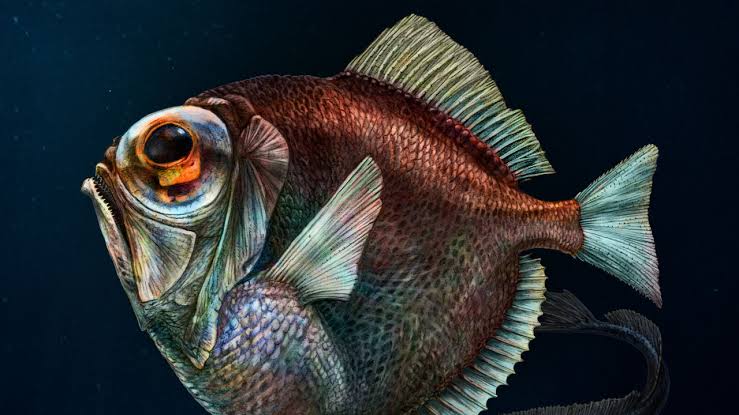
Fish eyes do not only inhabit brightly lit underwater zones. Many deep-sea inhabitants live in regions that receive little to no sunlight at all.
Some adaptations to living in the dark include:
– Bigger eyes to get more light
– More sensitive retinas
– Advanced vision systems
Some deep-sea fish have evolved to have disproportionately large eyes to help them capture more light.
Others, however, tend to rely on senses other than vision, such as detecting vibrations and electrical signals.
Some of the most interesting adaptations of fish eyes are a function of their habitat.
Predator Fish
Predatory fish have forwards positioned eyes to aid in distance perception and help accurately target their prey.
Prey Fish
Commonly hunted fish have sideways positioned eyes to help them maintain a look out for potential threats.
Surface Dwelling Fish
Some fish living closer to the surface of the water have adapted to see both above water and below with specialized eyesight.
Do Fish Blink?
One interesting question regarding the eyes of fish is if fish have the ability to blink, just like humans.
Since most fish do not have eyelids, they cannot blink in the way that humans do. Fish do, however, maintain the cleanliness of their eyes with a constant water supply.
To aid with eye protection, certain fish, like some species of sharks, have special protective membranes.
Significance of Fish Vision
Fish necessitate healthy eyesight to be able to navigate their day-to-day lives in their environment. Healthy eyesight allows fish to live by locating sources of food or shelter, identifying predators, or communicating and interacting with the other fish. The strong, healthy eyesight of many fish species gives them the ability to survive and reproduce.
Fish Eye Facts
Fish vision continues to be fascinating. These are some of the things that we are still learning:
– Not all fish can see the same colors. In fact, there are fish that can see colors that the human eye cannot detect.
– Fish that live in shallow environments can see clearly during the day and the night.
– Eyes of fish are still evolving, and so are their environments.
– To fish that live in the deep sea, light is a valuable asset. Those fish, then, have the largest eyes to aid deep sea fishing.
– Lastly, fish that are either hunters or the hunted can be differentiated by the position of their eyes.
Summary
Fishing eyes are a great example of design by nature. The unique engineering that fish eyes have allows focusing on the environment and the range of its vision.
From the shallowest of areas in the ocean to the deepest, fish are able to successfully evolve and develop systems suited to their environments.