


Bit Planes and Image Processing
Digital images are not as simple as they seem. Behind every digital image there is a complex structure. One of the many complex structures is the concept of bit planes. Digital images are broken down into binary forms. This form is the most efficient for manipulation and analysis by a computer.
In this article, we cover the operation and significance of bit-planes and their inclusion in image processing systems.
What Do You Mean by Bit Planes?
In order to understand the concept of bit planes, you first need to understand how digital images are stored in a computer. Digital images are stored in pixels. Each of these pixels can be broken down and represented in binary. An 8-bit grayscale image, for example, defines brightness levels of 8 bits ranging from 0 to 255.
Bit planes are layers of binary representation of a pixel and are defined as a collection of bits that are all of the same value.
An 8-bit image is made up of 8 bit-planes:
Bit plane 0 (Least Significant Bit – LSB)
Bit plane 1
Bit plane 2
Bit plane 3
Bit plane 4
Bit plane 5
Bit plane 6
Bit plane 7 (Most Significant Bit – MSB)
How Bit planes Work
Bit planes store values in binary (0 or 1), indicating whether that specific bit is set in each corresponding pixel. Combined, all bit-planes represent the original image.
Planes with higher significance and order carry more information and therefore structure higher order planes carry the most information and structure of an image. LSB planes add smaller variations and details to an image.
Omitting lower order planes most likely will not make an image unrecognizable, however, quality will suffer should the higher order planes be omitted.
This model is helpful to visually understand how data is organized in a digital image system.
Why It is Important
Bit planes are crucial to digital image processing for a few different reasons:
Efficiency in Compression Bit plane decomposition enables new ways of compression in which more important pieces of the image are maintained while the lesser important data (least significant bit-planes) are omitted.
Reduction of Noise Lower bit planes carry a lot of noise. Their omission or alteration increases image quality.
Addition of Features Manipulation of particular bit-planes can improve contrast and add more detailed variations of an image.
Steganography is a fascinating field. One of its most popular applications is embedding secret messages within images via modulation of the least significant bit-planes.
Bit Planes
Bit planes divide an image into binary structures or components. It is used in digital image processing to simplify complex image datasets.
In medical imaging, bit plane analysis can isolate different structures within a scan. In environmental studies, it can help observe the changes in a particular area and its landscape over a certain time period.
Bit plane analysis is used in various research activities to demonstrate how an image is constructed in binary format.
Bit Plane Slicing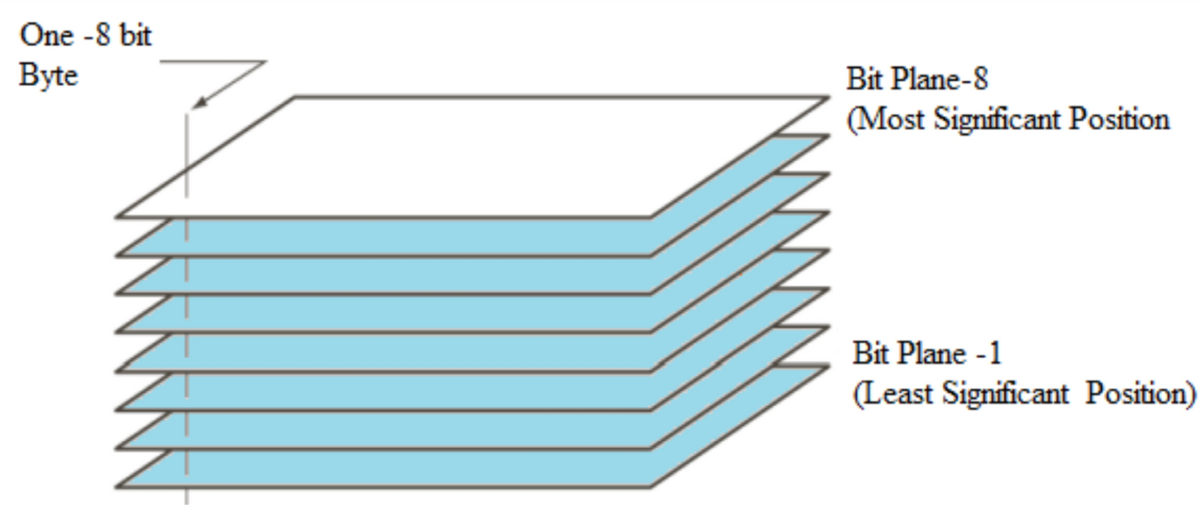
Bit plane slicing is a technique that separates an image into all its constituent bit-planes.
All separately sliced bit-planes can be represented in a bi-chrome format (black and white) to depict various bit planes.
Bit planes that depict higher significance will contribute to the quality and structure of the image. On the other hand, bit-planes that depict lower significance will generally carry noise.
Bit plane slicing is a popular technique in the imaging industry, especially in compression and enhancement.
Bit Planes in the Modern World
Bit planes have an extensive range of applications in many industries, such as:
Medicine: Enhanced X-rays and MRI Scans.
Remote Sensing: Analyzing Satellite Images.
Security Systems: Image Encryption and Watermarking.
Digital Communication: Transmission of Images in a More Efficient Manner.
Artificial Intelligence: Image Preprocessing for other ML Models.
The widespread adoption of bit-planes illustrates their importance in the field of technology.
Conclusion
In image processing, bit planes demonstrate the binary structure of digital images. IT allows image data to be segmented in a more structured way for easier data manipulation.
New computing techniques have capitalized on the utility of bit-planes, including compression, noise reduction, steganography, and medical imaging.
Bit planes are the building blocks of any image in the digital frame today.