

Introduction
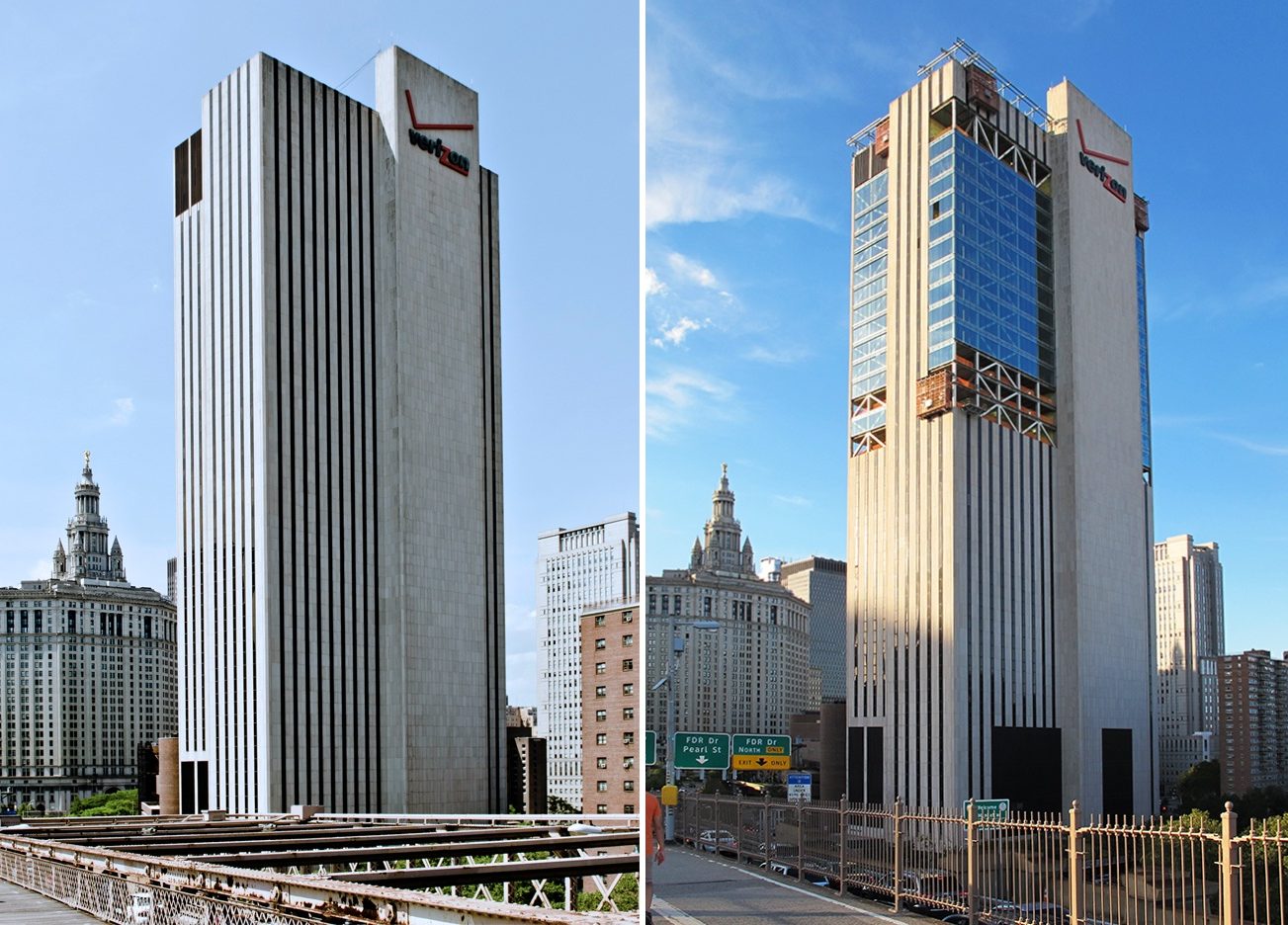
375 Pearl Street is one of the most unique and interesting skyscrapers in New York City. Started as an important telecommunications building, and now a vital part of data center services and digital infrastructures, its transformations exemplify the industrial architecture character of the building.
Many of the newer, sleek glass skyscrapers have designs that are more refined. Because 375 Pearl Street has been designed in a purposeful manner that allows for the building’s use to change and has character, it has a sleekness that many of the newer designs do not.
The Telecommunications Skyscraper
The construction of 375 Pearl Street was completed in 1975 and was done to accommodate the growing needs of the New York Telephone Company, which has since merged with other telecommunications companies to become part of Verizon Communications. 375 Pearl Street was built to support a massive telephone switching hub.
Since it was designed to support telecommunications infrastructure, its design did not include the elements of a typical office building, such as a lobby or open offices.
Eventually, technology continued to improve, and the need for large physical switching centers decreased, leading to the repurposing of the building.
Architecture and Design
The fortress-like feel of 375 Pearl Street is one of its most distinguished features. The building is a 32-story cement structure with very few windows and a solid structure.
In comparison to contemporary glass skyscrapers, 375 Pearl Street became a solid structure with utility first and foremost. Its design contains:
Exterior walls that are thick and reinforced concrete
Walls with few windows due to design and equipment
Floors large enough for telecommunication equipment and reinforced to support
An Industrial design that sacrifices aesthetics for a purposeful structure
Most unusual of Manhattan’s skyscrapers is how 375 Pearl Street is identified due to the criticisms of its design. While unattractive to some, it shows the honesty of lack of design and pure function.
Its design shows the collision of the function of the industrial age and the technology and the need for a building with little thought for its commercial function.
Modern Transformation into a Data Center
As the technology of communication improved, the function of 375 Pearl Street became outdated. Instead of allowing the building to become a relic, the function was transformed.
Now it is mainly a data center and a colocation center.
These are advantages which already existed.
Strong floors with a high load bearing capacity
Strong infrastructure for power supply
A controlled and secure environment
A central location with excellent connectivity
All these advantages offer the possibility for support of various modern services, such as those of the internet, finance, and business.
Considering the Facility: The Significance of Modern Digital Infrastructure
Given all the advantages stated above, 375 Pearl Street, in today’s world, is of greater value than what its exterior shows. It is a hidden resource for a large network of connective services in New York.
The building houses:
Cloud Services
Financial Trading Services
Telecommunication Services
Internet Services
Enterprise Data Services
The strategic location of the building, coupled with strong and adequate infrastructure, makes 375 Pearl Street very important for fast and reliable digital communications in one of the busiest cities in the world.
Urban Impact and Perception
375 Pearl Street has earned mixed reviews from urban planners and the general public. To some, it is one of the stiffest competitors for the Manhattan’s Least Attractive Building award. To others, it is one of the most critical and important building.
Now, with the new makeover as a data center, people now consider it an old industrial building and a remnant of the economy of the digital age. The change shows the new trend in the old industrial relics of the urban landscape. The buildings have been designed to fit the latest demands of modern technology.
Future Outlook
375 Pearl Street will always be an integral part of the global infrastructure as IT demand, telecommunication needs and the digital cloud continue to grow.
The continual increase in the desire to have facilities that are more energy efficient, less carbon intensive, and more sustainable, will prompt more changes to this building.
Conclusion
375 Pearl Street demonstrates the ability for buildings to incorporate changing technological needs. It has changed from a telecommunications building to a data facility that supports the telecommunications needs of the global community.
Its unconventional façade serves its purpose in the current reality. It demonstrates that greater value in a building is not in its outer appearance, but how adaptably purposeful it is, and how functionally it can serve a community, over time, in a constantly changing environment.