

Introduction Pitman Arm
Car enthusiasts and casual drivers alike can appreciate that a car’s functionality comes from several interconnected subsystems, one of the most crucial being the steering subsystem. Though they may focus more on the steering wheel and the tires, there are several small parts that aid in the safety and responsiveness of the vehicle. One of those major components is the pitman arm.
- Introduction Pitman Arm
- What Does a Pitman Arm Do?
- Pitman Arm Design and Construction
- What is the Function of a Pitman-Arm?
- Signs of a Bad Pitman Arm
- Issues Associated with Pitman Arm Failure
- Pitman Arm Care
- Pitman Arm Replacement
- Setting the steering to the right alignment
- Automotive Engineering and the Pitman Arm
- Pitman Arm Conclusion
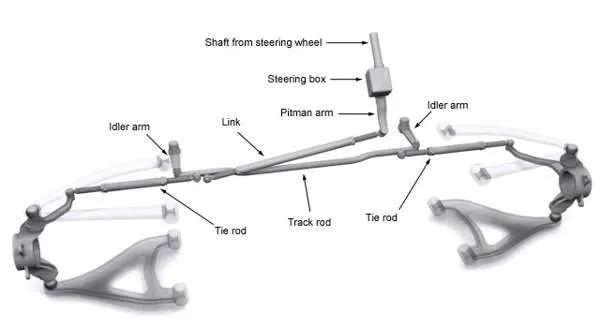
The Pitman-arm is the component of many conventional steering systems, and particularly of those systems that employ a recirculating ball steering, that aids the transfer of motion from the steering gear box to the steering linkage in order for the wheels to be turned.
This guide covers the function, design, types and the automotive significance of the Pitman-arm.
Pitman Arm Definition:
The pitman arm is a steering system component that connects the steering gear box and the steering linkage. It is primarily used to transform the steering gear box’ rotational movement to the lateral movement that is necessary to manipulate the vehicle’s front wheels.
When the driver of a vehicle rotates the steering wheel, the steering gear box moves the Pitman-arm. The arm then interacts with the steering linkage to manipulate the wheel’s direction.
The Pitman arm is found in:
Conventional steering boxes
Heavy trucks
Older passenger vehicles
Certain commercial vehicles
Modern vehicles with rack-and-pinion steering do not have Pitman-arms.
What Does a Pitman Arm Do?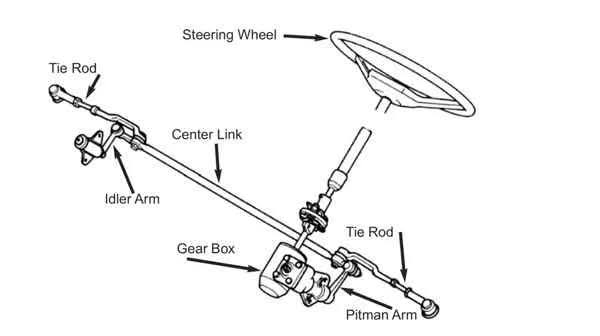
The pitman arm’s main job is to convey a driver’s steering input to the wheels.
This includes:
Transferring Steering Motion
The Pitman-arm conveys the force through the steering gearbox and onto the steering linkage.
Control of Direction
The pitman arm moves the wheels in the desired direction via the driver’s action on the steering wheel.
Maintaining Steering Function
The arm plays an important role in the response and control of the vehicle’s steering.
A steering system without a Pitman-arm is ineffective.
Pitman Arm Design and Construction
Pitman arm design and construction are focused around strength because the arm is subjected to large forces during driving.
Generally, a pitman arm is designed with:
Forged steel or some other strong metal alloy
A splined connection to the steering gearbox
A tapered connection to the steering linkage
The arm’s strong and tapered construction can withstand the stresses of driving and the repeated use of the steering.
What is the Function of a Pitman-Arm?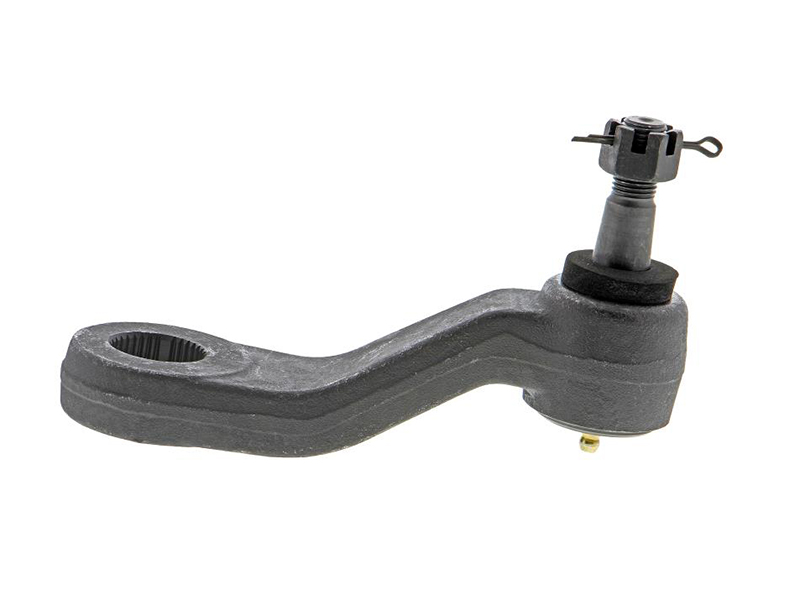
The function of a pitman arm, like the other components of steering, is dependent on a series of linkages and motion transfers.
This involves:
A driver turning the steering wheel.
Movement of the steering shaft which is then connected to the steering gearbox.
Rotation of the pitman arm via the steering gearbox.
Movement of the steering linkage by the Pitman-arm.
The Pitman arm is used in a car to help turn the wheels through a series of linkages. This helps the driver turn the car in different directions. Depending on its steering design to facilitate different styles of steering, a vehicle may require a different type of Pitman-arm.
Standard Pitman Arm
This arm is commonly used in many of the old or traditional styles of steering.
Offset Pitman-Arm
This arm changes the steering link’s position for better clearance or steering alignment.
Drop Pitman Arm
This version of the Pitman Arm is used for adjustment of the steering (its geometry) for suspension changes. These changes modify the vehicle.
They are all important for the requirement of the vehicle.
The pitman arm is important for safe functioning of the vehicle. Its proper use and functioning provide for safety in the vehicle. There are many reasons that you need to assess the steering of your vehicle. This helps maintain safety.
This is what you stand to lose if you ignore the assessment of the functioning of the Pitman-arm of your vehicle.
Signs of a Bad Pitman Arm
The Pitman arm may get damaged after being in use for long period of time through wear and tear.
These are signals of a damaged pitman arm
Steering wears loss
The pitman arm may get worn out and there may be significant play in the steering wheel.
Poor Steering Control
Resistance may be felt mostly and steering may be untimely and of poor quality.
Wandering
The car may steer in a different direction and cause the vehicle maneuver in an uncontrolled manner on the road.
Uneven wear
The wheels and tires may get worn out and the vehicle may steer in an uncontrolled manner.
Consequences may worsen if these are not heeded to.
Issues Associated with Pitman Arm Failure
There are many things that can lead to the failure of a Pitman-arm.
Some of the most common causes may include the following:
Routine wear
Inadequate lubrication
Faulty parts of the steering system
Undue stress on the vehicle
Driving on rough surfaces
Routine checks can assist with identifying issues before they become major problems.
Pitman Arm Care
With the right care and maintenance of Pitman-arms, their life span can be increased.
Some of the most essential maintenance are:
Frequent checks on the whole steering system
Look for looseness and damage
Ensure lubrication
Replace parts that are damaged or worn
If there is a sign of a steering issue, care should be taken to seek the advice of a professional.
Pitman Arm Replacement
Pitman-arm replacement can be tricky and is a time-consuming task that requires the right equipment and know-how due to the way they are connected to the whole steering system.
The process usually is:
Removal of the old arm
Assessment of the other steering components
Addition of the new component
Setting the steering to the right alignment
Since steering is a critical safety concern, this process becomes even more important to get right.
Pitman vs Idler Arm
In most traditional vehicle steering systems, Pitman and Idler arms collaborate, but have different responsibilities.
The movement from the steering gearbox is received by the Pitman-arm, and the Idler arm supports the steering linkage on the other side.
Both arms are necessary to ensure the movement and alignment of the system and steering are correct.
Automotive Engineering and the Pitman Arm
The varm shows an important part in the timeline of automotive engineering.
Although many current day vehicles utilize other steering systems, the Pitman-arm is still used:
In vehicles built for heavy duty
Older, classic vehicles
Trucks
In other special systems
It’s design demonstrates simplicity, however, it has proven to be very effective in providing a reliable control of steering for the last several decades.
Pitman Arm Conclusion
The Pitman Arm is an integral component of the steering system. It translates driver input to movement in the wheels. Its strong design translates driver input with precision and reliability to support safe driving.
Knowing its functions, signs and precautions helps drivers better understand the input in their steering systems. Whether in Trucks, vintage cars or old fashioned steering systems, the Pitman-Arm is a testament to functional and practical design in automotive engineering.